
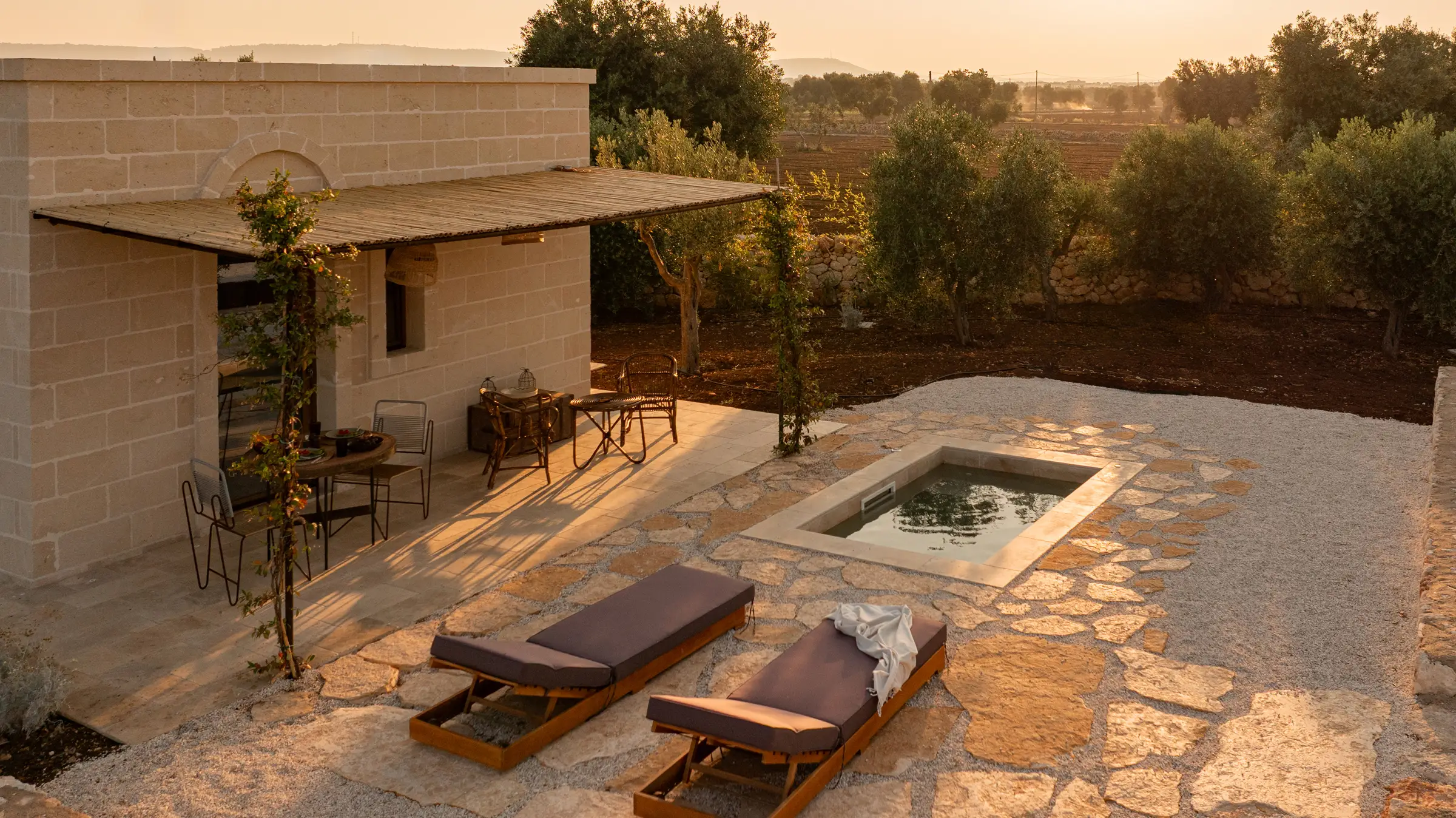
Most people who return to Puglia year after year struggle to explain exactly why. The landscape is not the most dramatic in Italy. The towns are not the most famous. What the region does — quietly, without advertising it – is reward attention. The more you know before you arrive, the more you find when you are there. That is not a coincidence. It is the structure of the place.
Why visit Puglia in 2026 specifically? Because the gap between what the average visitor experiences and what the region actually offers has never been wider. Which side of that gap you land on depends almost entirely on preparation.
What follows is the frame for that decision — the context, the honest account of what the region is, and why 2026 is a particular moment to go. The specifics — the areas, the calendar, the version of Puglia that makes the journey make sense — are the part we cover privately, before guests travel, not in a public article.
| ✦ CURIOUS FACT
Castel del Monte — the octagonal fortress built by Frederick II around 1240 near Andria — was designed with a solar geometry that remains only partially explained. At sunrise on the spring and autumn equinoxes, light enters through specific windows and traces the exact outline of the inner courtyard. The precision required for this alignment, using 13th-century instruments, has no documented parallel in medieval European architecture. UNESCO listed it as a World Heritage Site in 1996. |
The Reality of Puglia in 2026: What Has Changed and What Has Not
Puglia has been discovered. The travel pieces arrived, the low-cost routes from London, Manchester and Dublin expanded, and the trulli multiplied across Instagram. None of that has changed the underlying quality of the region — but it has changed what it means to visit it without preparation.
Alberobello receives close to 8,000 visitors a day in July and August. The Itria Valley is genuinely remarkable, but walking through it at noon between tour groups from Bari is a different experience from arriving before the coaches. Polignano a Mare draws significant crowds from May through September. Ostuni — still described as undiscovered in some travel pieces — had that moment a decade ago. The honest picture includes all of this.
The reason this does not make Puglia less worth visiting is that the crowds are concentrated: specific towns, specific hours, specific months. Someone who knows the region can work around the problem almost entirely. Someone who does not will spend a week in its most generic version and wonder what the writing was about.
Six Reasons Puglia in 2026 Is Worth the Journey
- The food is not a cliché. Puglia’s kitchen is among the most honest in Italy. Orecchiette with cime di rapa, fava bean purée with wild chicory, burrata made the same morning in a dairy twelve kilometres from where you eat it. No heavy sauces, no complexity for its own sake. The ingredients are not imports. What changes the experience is knowing which version of each dish to find, and where the production actually happens rather than where it is performed for visitors.
- The coast is longer and more varied than most people expect. Over 800 kilometres of coastline. The Adriatic side is rocky and clear; the Ionian has long sand beaches with a quality of light that reads more like Greece than Italy. The well-known spots are genuinely beautiful and, in summer, genuinely crowded. The calibration between those two facts is what a considered base in the right area solves.
- The interior is largely off the tourist circuit. The Valle d’Itria — the valley of trulli farms and ancient olive groves running between the hill towns of the southern Murge — is one of the few parts of Italy where the landscape has not been substantially altered by modern development. Masserias, the fortified farmhouses that functioned as self-sufficient estates for centuries, sit in working olive groves. The best of them have been restored to a standard of care that is difficult to find in more frequented regions.
- The harvest season changes the character of the region. September and October bring the Vendemmia — the Primitivo grape harvest in the Manduria area, followed by the olive harvest across the Itria Valley and the Salento in late autumn. Private estates open for the season in a way they do not in summer. What that means for a specific stay — which estates, which timing, what the experience actually involves — belongs in a conversation rather than an article.
- The distances are honest. Puglia is a region you can cover from a single base without long daily drives. Lecce — the baroque capital of the south, built almost entirely in the 17th and 18th centuries from the local golden sandstone — is under an hour from most of the Valle d’Itria. Matera, in neighbouring Basilicata, is roughly two hours west. The geography rewards a considered plan rather than a loose itinerary.
- The crowds are predictable and avoidable. Unlike Amalfi or Cinque Terre, where the geography concentrates visitors in narrow corridors, Puglia’s crowd problem is confined to specific places and specific months. An informed approach to timing and positioning avoids most of it. A week built around the right base — away from the main circuits, close enough to visit when it is worth visiting — barely intersects with the version of Puglia that most first-time visitors experience.
Why the Base Matters More Than the Itinerary
Everything described above depends on where you are staying. Not the specification of the property — though that matters — but its positioning. A masseria in the right part of the Valle d’Itria puts you twenty minutes from Alberobello at the hour it is worth visiting, forty minutes from Lecce, close enough to the Adriatic to reach the coast before it fills. A property in the wrong location adds friction to every decision.
The base also determines the rhythm of the week. A private pool and a kitchen worth cooking in change the logic of the day: you do not need to organise every meal outside, you do not depend on restaurant timings, and you are not filling the hours between fixed points. You can be selectively present in the places that deserve attention and entirely absent from the rest. That is not an argument for staying in. It is an argument for choosing when and where to go out.
For car hire, we work with Club & Cars — they handle airport collection and drop-off at both Bari and Brindisi and are familiar with the requirements our guests have. A car is not optional for this kind of stay; it is the mechanism that makes it work.
The Part That Does Not Belong in a Public Article
There is a version of this article that would name the access route into Alberobello that the tour buses do not use, the estate in the Manduria hills where a harvest dinner in October is worth rearranging a schedule for, the stretch of Ionian coast that requires fifteen minutes on an unmarked path and has no equivalent in the travel press. That version of the article would be read once, shared widely, and cease to be accurate within a season.
What we publish is the frame. The substance inside it — the specific places, the right timing, the choices that make the difference between a good week and a genuinely different one — is what the conversation before the trip is for. Every guest we work with speaks with someone who has been to the places in question before they travel. Not a suggestions document, not a recommended-reading list. A direct conversation about what a particular group needs from the week, and how to build it.
That conversation is where the article ends and where the useful part begins.
Three Things to Take From This
First: Puglia in 2026 rewards preparation more than almost any other destination. The crowds are real, containable, and — with the right timing and base — largely avoidable.
Second: The interior — the Valle d’Itria, the working masserias, the harvest season — is more interesting than the coast-and-trulli version of the region that most first-time visitors see. The two are compatible; the interior is just the part that requires more context.
Third: The gap between a good week and a genuinely different one is almost entirely about detail — the kind that does not survive being put in a public article.
| Everything in this article is the part we can share publicly. If you are planning a week in Puglia, the conversation before you travel is where the rest of it lives — the specific places, the timing, the things that do not survive being written down. Get in touch and we will make time for it. |
FAQ
Is Puglia too touristy in 2026?
The most-visited towns — Alberobello, Polignano a Mare, Ostuni — are genuinely busy in July and August. The rest of the region is not. The problem is concentrated enough that it is almost entirely avoidable with the right timing, base, and awareness of which places to visit at which hours.
When is the best time to visit Puglia?
Late May through June and September through mid-October give the best combination of weather, smaller crowds, and a region that is fully open. September is the month the region’s character shifts most noticeably — the harvest begins, the heat softens, and the quality of light changes in a way that is worth travelling for specifically.
What is the Valle d’Itria?
The Valle d’Itria is the valley at the heart of the Murge plateau, running roughly between the towns of Alberobello, Locorotondo, Martina Franca and Cisternino. It is the area most associated with trulli — the dry-stone houses with conical roofs — and with working olive and almond groves. It is the most photographed part of Puglia and also, in the right conditions, the most genuinely worth the attention.
How long do you need in Puglia?
Seven nights is the natural unit. It gives enough time to settle into a base, cover the main areas without rushing, and have at least two or three days with no fixed plan. Five nights is workable but tends to produce a week where you are moving more than staying. Ten nights or more is for people who have been before and know what they are returning to.
Is a car essential in Puglia?
Yes, for any stay that involves a private villa or masseria. Public transport connects the major cities adequately, but the places that define the private-stay experience — the working estates, the coastal approaches, the smaller towns — are only reachable by road. The airport collections at Bari and Brindisi are the natural starting point; the drive time to the Valle d’Itria from either is under an hour.
What is a masseria?
A masseria is a fortified farmhouse, historically the self-contained estate at the centre of agricultural life in Puglia. The word comes from the Latin massa — an estate worked by bonded labour. The great masserias of the 17th and 18th centuries had their own chapels, oil presses, water cisterns and watchtowers. Many have been restored as private properties; the best of them retain the working character of the original estate while operating at a standard that has no equivalent in a hotel.
What is the food like in Puglia?
Puglia’s cuisine is built on a small number of high-quality local ingredients prepared with minimal intervention. Orecchiette pasta with cime di rapa (turnip tops), fava bean purée served with wild chicory, burrata from the dairies around Andria, and grilled lamb and kid from the interior. The olive oil — Puglia produces more than any other region in Italy — is present in everything. The best version of this food is not found in the most-visited restaurants.
Is Puglia suitable for families with children?
It is one of the most practical regions in Italy for a family stay. A private masseria with a pool and grounds means children are not confined to a hotel room or a small terrace. The sea on both coasts is calm and clear. The main towns are manageable on foot. The practical difficulty — logistics that require hourly planning — disappears when the base is right.
