
Puglia has spent the last decade arriving. It appeared in The Guardian, National Geographic Traveller UK and Lonely Planet across the same twelve months in 2025 — not as a footnote in a southern Italy feature, but as the subject. The region received 6.7 million visitors that year, with international arrivals growing by more than 25 per cent. The British audience is, by some measures, the most significant driver of that growth: more direct flights from the UK land in Bari and Brindisi than from any other European country.
What follows is the honest version of what a UK visitor needs to know before booking. The geography, the timing, the crowd reality, and what the trip actually involves when you get it right. This article gives you the frame. The specific places, the right positioning, the version of the week that makes the journey worth it — those are things we cover in the conversation we have with guests before they travel, not in a public article.
| ✦ CURIOUS FACT
The United Kingdom operates more direct flights to Puglia than any other European country — a consequence of the region being discovered by British travel writers in the late 2000s, when it was largely unknown outside Italy. Ryanair and EasyJet now connect Bari and Brindisi with London, Manchester, Edinburgh and Dublin year-round. The result is that British visitors are, alongside Germans and Americans, consistently the largest international group staying in the private villas of the Valle d’Itria. The infrastructure that makes the journey straightforward is almost entirely the product of a decade of editorial attention from the UK press. |
The Honest Picture: What Puglia Is and What It Is Not
Puglia is a long, narrow region that fills the heel of Italy’s boot — roughly 400 kilometres from the Gargano promontory in the north to Santa Maria di Leuca at the southernmost tip. It sits between two seas: the Adriatic to the east, the Ionian to the west. The landscape is not uniformly dramatic. It is largely flat, agricultural, and defined by what grows in it: olive groves, almond trees, vines, wheat fields. What makes it worth the journey is not any single spectacle, but the accumulation of things that are specific to this place and nowhere else in Italy.
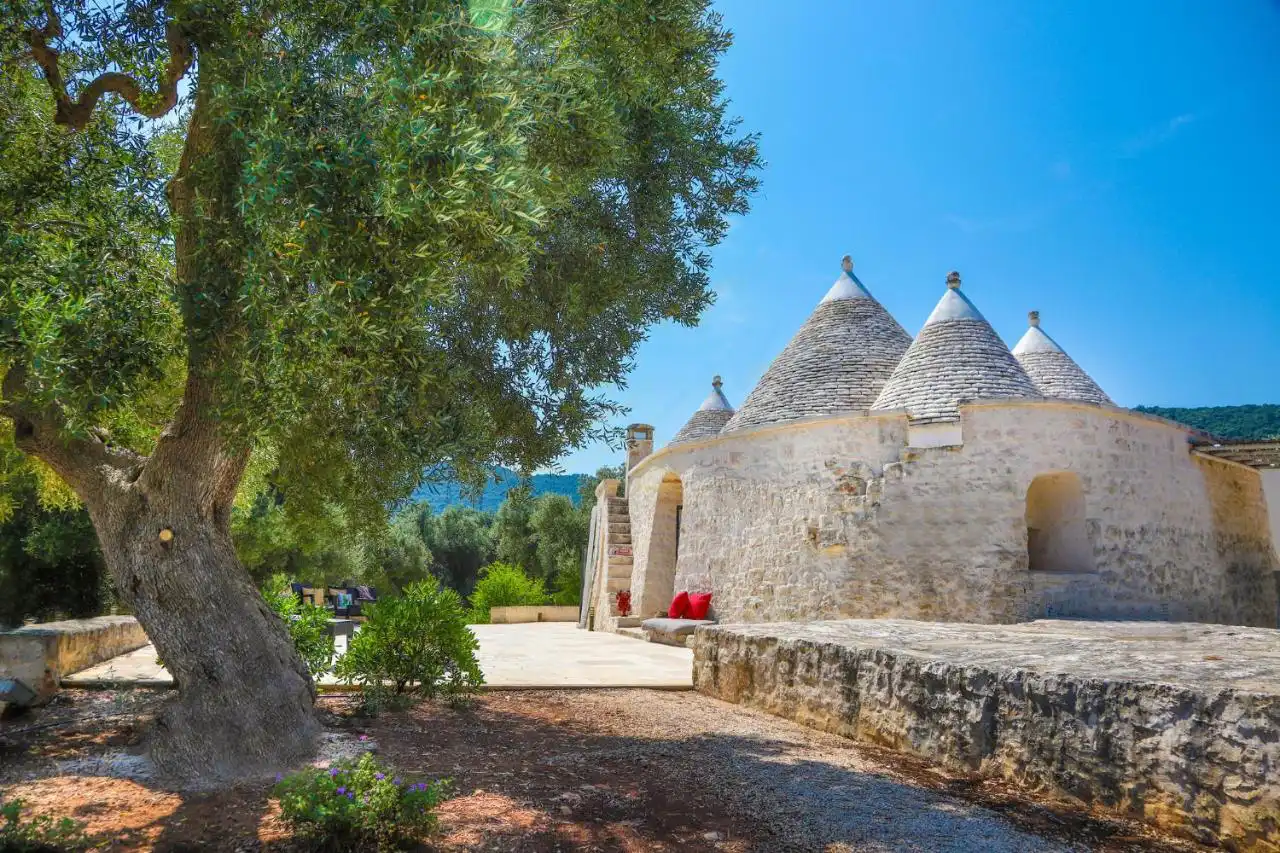
The trulli — the conical dry-stone houses of the Valle d’Itria — are genuinely unlike anything in the country. The baroque architecture of Lecce, built almost entirely from the local golden sandstone, is in a different register from Rome or Florence. The olive oil produced here — Puglia makes more than any other Italian region — has a freshness and intensity that the blended products sold under other regional names do not. The sea on both coasts is clear in a way that the more celebrated coastlines of the north rarely match in summer.
The honest qualifier: the best-known version of Puglia has crowds. Alberobello receives around 8,000 visitors a day in July and August. Polignano a Mare in peak season is a city of tourist queues. Ostuni — still described as ‘undiscovered’ in some travel pieces — had that moment a decade ago. The press attention that made the region accessible also made its most photographed corners predictable. This is not a reason to go elsewhere. It is a reason to understand the geography of the crowds before you build the week.
The crowds are concentrated in specific towns, at specific hours, in specific months. Someone who knows the region can avoid them almost entirely. The Guardian understood this when its readers nominated Locorotondo and Nardò as two of Italy’s ten most recommended destinations in February 2025 — not the obvious names, but the ones that hold up when you look past the obvious.
When to Go: The Case for the Shoulder Season
The question of timing matters more in Puglia than in most Italian regions, because the difference between high summer and the months either side of it is not just a matter of temperature and price. It changes the character of the place.
July and August are when Italy takes its holidays. The beaches are full, the restaurants book out weeks in advance, and the towns on the main tourist circuit are operating at a density that removes much of what makes them worth visiting. Lonely Planet, in its updated 2026 guide, is direct about this: the months before and after the peak are when Puglia offers peace, charming towns and empty water. National Geographic Traveller UK dedicated a full feature in September 2025 to a slow road trip through the Salento — deliberately timed for the period when the region returns to something closer to itself.
Late May and June give you warm days, a sea that is already swimmable, and a region that is fully open but not yet pressured. September is the month that most people who know Puglia well return to. The harvest begins — the Primitivo grape in the Manduria hills, the olives across the Valle d’Itria and the Salento from October — the light changes, and the quality of the days shifts in a way that is difficult to describe but easy to recognise. By early October, the shoulder is over and parts of the coast begin to close for the season.
For a villa or masseria stay, late May to June and September are the months worth building the trip around. The specifics of how to use each period — which estates are open, what is actually happening in the countryside, and how to position the week — are the kind of detail that belongs in a conversation rather than an article.
Getting There and Getting Around
From the UK, Puglia is well connected. Ryanair and EasyJet operate direct flights from London Stansted, London Gatwick, Manchester, Edinburgh and Dublin into both Bari and Brindisi. Flight times are in the region of two and a half to three hours. Bari is the more useful airport for the northern half of the region, including the Valle d’Itria; Brindisi serves the south and the Salento more directly. In most cases, the drive from either airport to a private property in the countryside is under an hour.
Once there, a car is not optional. Public transport connects the major cities — Bari, Lecce, Brindisi — adequately by Italian standards. Everything else requires a car: the countryside, the smaller hill towns, the private properties, the beaches that are not accessible from a promenade. The roads in Puglia are, by comparison with the Amalfi Coast or the Sicilian interior, straightforward — largely flat, well maintained, and easy to navigate.
For car hire, we work with Club & Cars. They handle airport collection and drop-off at both Bari and Brindisi and are familiar with the requirements of guests staying in private properties in the region. A car collected at the airport on arrival is the natural starting point for any villa stay — it is the mechanism that makes everything else possible.
What a Week in Puglia Actually Involves
The Valle d’Itria is the natural centre of gravity for most private stays. It is the valley that runs roughly between Alberobello, Locorotondo, Martina Franca and Cisternino — hill towns connected by roads through working olive groves and scattered trulli farms. From a base here, the whole of Puglia is within range: Lecce is under an hour to the south-east, Matera in neighbouring Basilicata is two hours west, the Adriatic coast is thirty minutes, the Ionian is an hour.
A week built from this base does not need to involve long daily drives. It involves choosing. Alberobello is worth visiting — the concentration of trulli in the Rione Monti is genuinely remarkable — but the timing of that visit changes the experience entirely. At eight in the morning, before the coaches arrive, the streets are quiet and the scale of what was built there becomes legible. By eleven, the town is a different place. The same logic applies to Polignano, to Ostuni, to most of the sites that attract large numbers. They are worth seeing; they require a different relationship with the clock than most visitors apply.
The food in this region requires no special effort to find. Orecchiette with cime di rapa — the pasta shaped by hand and paired with braised turnip tops — is the regional dish and appears in every trattoria. Burrata made the same morning in a dairy near Andria is available at the kind of roadside shops that exist in places where the product is made, not displayed. The olive oil is a different substance from what most visitors are used to: freshly pressed, green-tinged, with an intensity that fades over the course of a year. Whether any of this is experienced at the level it is capable of depends almost entirely on where you eat and who has told you where to go.
Lonely Planet has updated its Puglia coverage substantially for 2026, noting that the region is emblematic of everything Italy does best: the landscape, the history, the food. That is accurate as a summary. The gap between that summary and the specific experience of a week that justifies the trip is what the detail is for.
Why the Base Matters More Than the Itinerary
Most of what makes a week in Puglia work well is determined before the first day. Not by the itinerary — Puglia rewards the flexible week, not the scheduled one — but by the base. Where a property sits in the landscape, its distance from the things worth visiting, the quality of what it offers when you are not somewhere else: these are the decisions that shape the rest.
A private masseria in the right part of the Valle d’Itria puts you twenty minutes from Alberobello at the hour it is worth visiting, forty minutes from Lecce, close enough to the Adriatic coast to reach it before it fills. A kitchen worth cooking in means you are not organising every meal outside. A pool in a working olive grove means the hours between excursions have a different quality from a hotel terrace. The property is not the destination — but it is the platform from which the destination is experienced.
We have written in more detail about the specific reasons Puglia holds up as a destination in 2026 — the food, the coast, the interior, the harvest season, and why the base matters more than the itinerary — in a separate piece on this site.
It is worth reading alongside this one. This article gives the context; that one gives the reasoning behind each specific decision.
The Part That Does Not Belong in a Public Article
The Guardian, National Geographic Traveller UK and Lonely Planet all did their jobs well in 2025. They described the region honestly, flagged the tourist concentrations, and pointed toward the places that hold up under scrutiny. What they cannot do — because no public article can — is tell you the things that lose their value the moment they are written down.
The restaurant with no English menu that has served the same dish for forty years and does not appear on any booking platform. The stretch of Ionian coast that requires fifteen minutes on an unmarked path. The estate in the Manduria hills that opens for harvest dinners only to those who know to ask, and books out by July. The entrance into Alberobello that the coach tours do not use. These are the details that change a week from good to genuinely different — and they are the details that we cover in the conversation we have with every guest before they travel.
That conversation is not a suggestions document or a recommended-reading list. It is a direct exchange with someone who has been to the places in question, knows the properties, and can give specific, unfiltered guidance calibrated to what a particular group actually needs from the week.
Three Things to Take From This
Puglia is worth the trip, and the timing of it matters more than almost any other decision you will make. The shoulder season — late May to June, and September — is when the region is most itself: the crowds have not arrived or have left, the food and landscape are at their best, and the properties are fully operational. The press has understood this: what The Guardian, National Geographic and Lonely Planet are recommending is not the August version.
A private base in the right part of the countryside makes the logistics straightforward and changes the rhythm of the week. And the difference between a good week and one that is genuinely worth building a trip around lies almost entirely in the detail — the specific detail that does not survive being made public.
| Everything in this article is the part we can share publicly. If you are planning a week in Puglia, the conversation before you travel is where the rest of it lives — the specific places, the right timing, the things that do not survive being written down. Get in touch and we will make time for it. |
FAQ
Is Puglia a good holiday destination for UK travellers?
Yes. Direct flights from London, Manchester, Edinburgh and Dublin make Puglia one of the most accessible parts of southern Italy from the UK. The region offers a combination of landscape, food and coast that has no direct equivalent elsewhere in Italy, and the flight time of under three hours means a week there involves no meaningful travel overhead. The British market is the largest international group visiting the Valle d’Itria, and the infrastructure — direct routes, car hire, private properties — is calibrated accordingly.
When is the best time to visit Puglia from the UK?
Late May to June and September are the months most worth building the trip around. The weather is warm, the sea is swimmable, the properties are fully open, and the region is not operating under the pressure of August. September is the month that most regular visitors return to: the Primitivo harvest begins in the Manduria area, the light changes in a way that is specific to autumn in the south, and the towns on the main tourist circuit return to something close to their normal character. Both Lonely Planet and National Geographic Traveller UK have pointed to this window explicitly.
How do you get to Puglia from the UK?
Ryanair and EasyJet operate direct flights from London Stansted, Gatwick, Manchester and Edinburgh to Bari and Brindisi. Flight times are between two and a half and three hours. Bari serves the northern half of the region and the Valle d’Itria; Brindisi is more useful for the Salento and the south. From either airport, most private properties in the countryside are under an hour by car.
Do you need a car in Puglia?
Yes, for any stay that involves a private villa or masseria. The major cities — Bari, Lecce, Brindisi — are connected by train, but the places that define the private-stay experience are only reachable by road. The driving in Puglia is not difficult: the terrain is largely flat and the roads are well maintained by comparison with other parts of southern Italy. Car hire collected at the airport on arrival is the standard starting point.
Is Puglia too crowded?
The crowds in Puglia are real and concentrated: Alberobello, Polignano a Mare and a handful of coastal towns in July and August. The rest of the region, and the entire shoulder season, is different. The key is understanding that the tourist concentration is geographic and seasonal — which means it is almost entirely avoidable with the right timing and base. The Guardian nominated Locorotondo and Nardò as two of Italy’s ten best destinations in 2025 precisely because they offer the character of the Valle d’Itria and the Salento without the volume of the more visited names.
What is the Valle d’Itria?
The Valle d’Itria is the valley at the heart of the Murge plateau, running between the hill towns of Alberobello, Locorotondo, Martina Franca and Cisternino. It is the area most associated with trulli — the dry-stone houses with conical roofs that are unique to this part of Puglia — and with working olive and almond groves. It is the natural base for a private stay in the region: well positioned for day trips in every direction, and with a landscape and density of private properties that the coast cannot match.
What is the food like in Puglia?
Puglia’s food is built on a small number of high-quality local ingredients prepared without intervention. Orecchiette pasta with cime di rapa, fava bean purée with wild chicory, burrata made the same morning in dairies near Andria, grilled lamb and kid from the interior. The olive oil — Puglia produces more than any other Italian region — is present in everything and is a different substance from most of what is sold elsewhere under Italian labels. The best version of this food is found in places that are not on the main tourist circuit, which is precisely why the specifics belong in a direct conversation rather than a public article.
What is a masseria?
A masseria is a fortified farmhouse — historically the self-contained estate at the centre of agricultural life in Puglia. The word comes from the Latin massa, an estate worked by bonded labour. The great masserias of the 17th and 18th centuries had their own chapels, oil presses, water cisterns and watchtowers. Many have been restored as private properties; the best retain the working character of the original estate — the olive grove, the stone architecture, the proportions of the rooms — while operating at a standard that has no equivalent in a hotel.
How long do you need in Puglia?
Seven nights is the natural unit. It gives enough time to settle into a base, cover the main areas without rushing, and have at least two or three days with no fixed plan. Five nights is workable but tends to produce a week with more movement than staying. Ten nights or more is for people who have been before and know what they are returning to.
